
How to Run a Cyber Compliance Assessment in 6 Steps
Knowing how to run a cyber compliance assessment turns a vague worry into a ranked list of fixes. This guide walks through scope, framework, evidence, scoring and the roadmap that follows.
Start With the Right Target
Decide what is in scope and which standard you are measuring against.
Read SectionFind and Rank the Gaps
Collect proof, score maturity and rank risks consistently.
Read SectionTurn Findings Into Action
Convert the gap list into a sequenced, owned and funded plan.
Read SectionKnowing how to run a cyber compliance assessment helps you replace assumptions with evidence. Instead of guessing whether you meet ISO 27001, the Essential Eight or a regulator's expectations, you measure it and decide what to fix first.
The process is the same for a 30-person business and a large regulated group, although the depth differs. The six steps below set out what to do, in order, and what each step should produce.
How to Run a Cyber Compliance Assessment: Scope and Framework
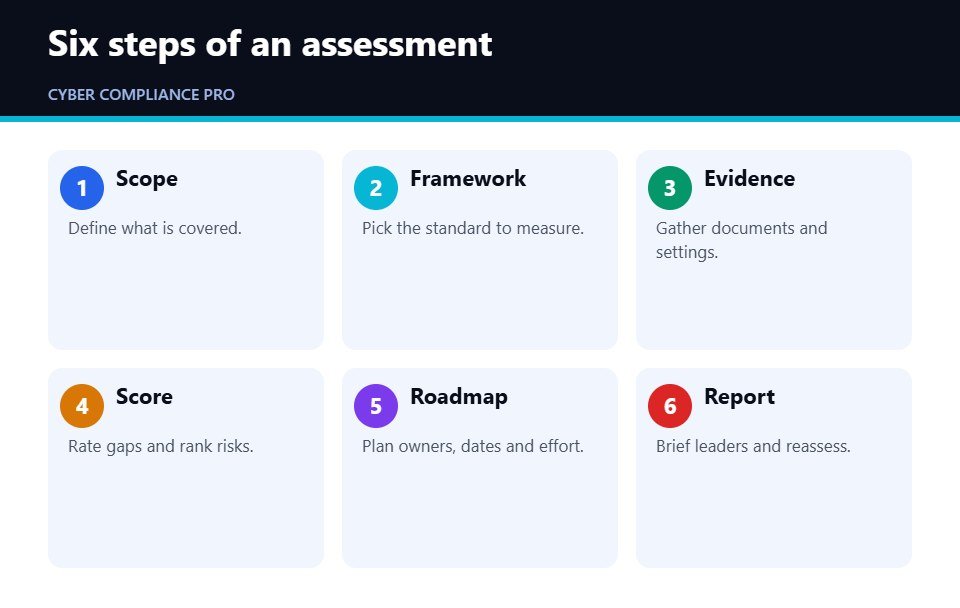
Begin by deciding what the assessment covers. List the business units, systems, sites and suppliers in scope, and note anything you are excluding on purpose. A clear boundary stops the work growing and keeps results comparable next year.
Then pick the framework to measure against. Choose according to your obligations and customers. Many Australian organisations use the Essential Eight as a baseline, ISO 27001 for certification, and sector rules such as APRA CPS 234 where they apply.
Write the scope and framework on one page and have an executive sign it. That small step prevents disagreement later.
Step 3: Gather the Evidence
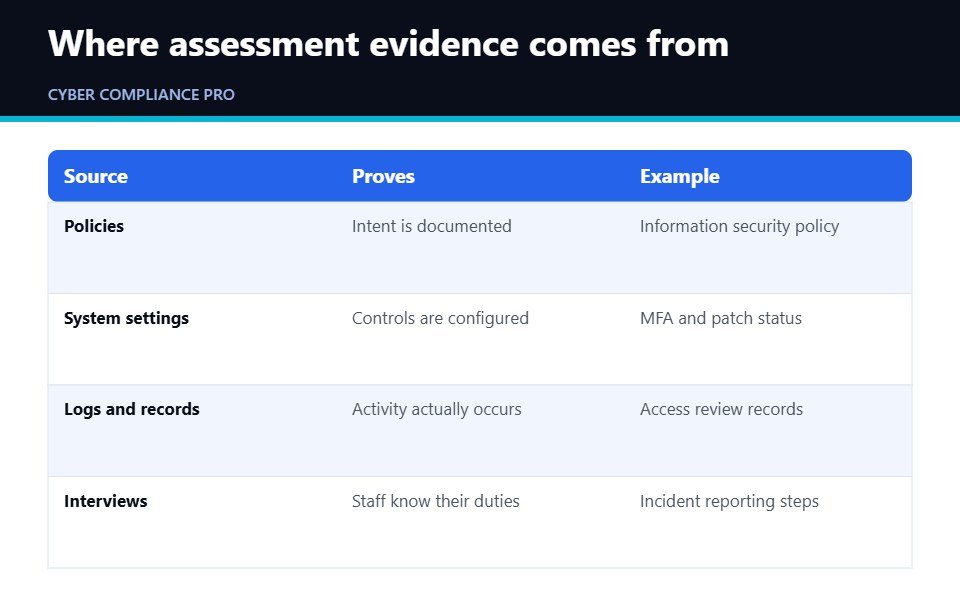
The next part of how to run a cyber compliance assessment is evidence, because an assessment is only as good as its proof. For each requirement, collect documents, system settings, logs and interview notes that prove the control exists and works.
Start with what you already have. Policies, network diagrams, asset registers, access review records and previous audit reports often answer many questions. Then fill the gaps with short interviews and spot checks of real systems.
Keep a simple evidence register that records the source, the date and who provided it. This saves time when an auditor or regulator asks how you reached a conclusion.
Step 4: Score the Gaps and Rank the Risks
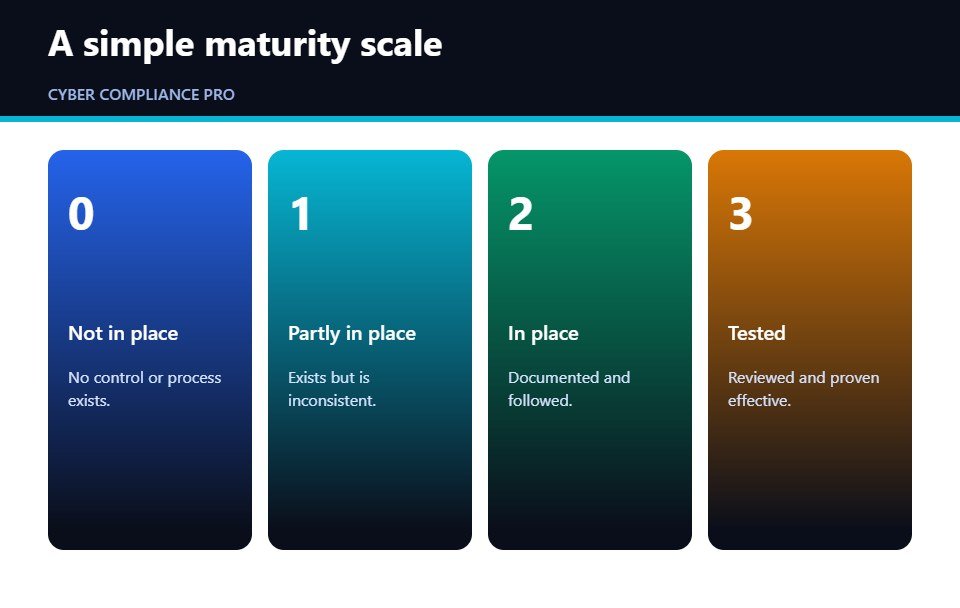
Next, score each requirement. A simple maturity scale, such as not in place, partly in place, in place and tested, works well because everyone can understand it.
Scoring alone does not show priority, so add risk. Ask how likely the gap is to be exploited and how serious the impact would be. A missing multi-factor authentication control on remote access, for example, usually outranks a formatting problem in a policy document.
Be consistent. Use the same scale across every area and record the reasoning for each score so a reviewer can follow it.
Short on time or internal capacity? Our cyber compliance assessment service delivers an independent gap report and a prioritised roadmap.
Step 5: Build a Prioritised Roadmap
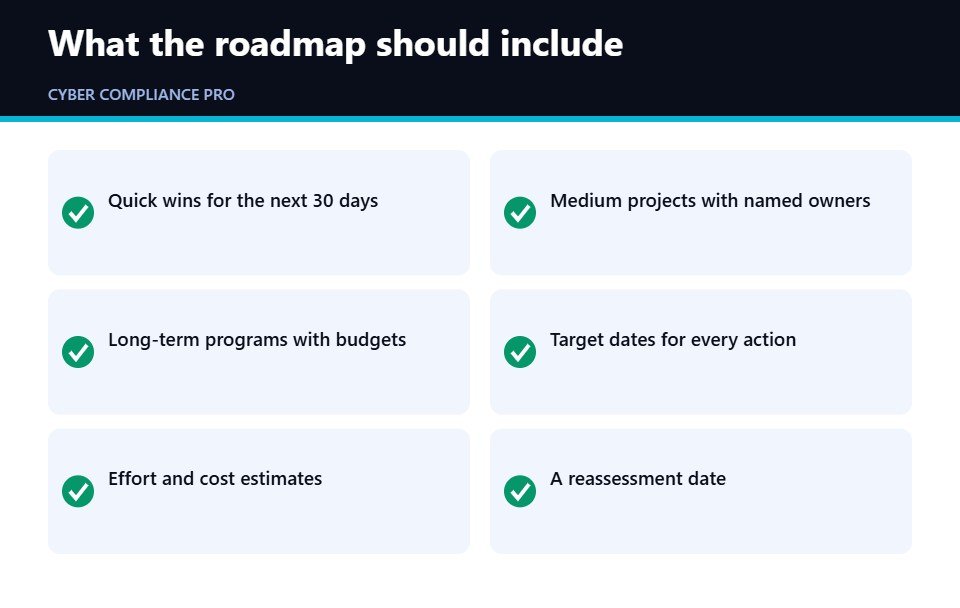
The roadmap is the most valuable output of any cyber compliance assessment. Group fixes into quick wins, medium projects and long-term programs, and give each an owner, a target date and a rough effort.
Quick wins often include enforcing multi-factor authentication, patching internet-facing systems and testing backups. Larger items, such as building an incident response capability, need budget and planning. If a response plan is missing, our cyber incident response plan template guide is a practical place to start.
Step 6: Report to Leadership and Reassess
Present the results in plain language. Show the overall maturity, the top risks and the plan to address them. Boards and executives respond to clear priorities and costs far more than to long lists of technical findings.
Finally, set a reassessment date. Compliance is not a one-off project, because systems, suppliers and threats change. Many organisations repeat a focused assessment every year and a full one every two to three years.
When you plan your next cycle, the same discipline applies to cybersecurity compliance consulting support: define scope first, then agree deliverables.
Common Mistakes to Avoid
Even when you know how to run a cyber compliance assessment, some assessments fail because the scope is vague. Others rely on self-reported answers without checking systems. A third group produces a long report that nobody acts on.
To avoid these problems, test a sample of controls directly, keep the report short and tie every finding to an owner. If you also hold personal information, pair the work with a privacy risk and compliance review so both views feed the same plan.
To see how an assessment differs from an audit, read what a cyber security audit covers.
Want an independent cyber compliance assessment for your organisation?
Get in TouchFrequently Asked Questions
It is a structured review that measures your security controls against a chosen framework or regulation, identifies gaps and ranks them so you know what to fix first.
A focused assessment of a small or mid-sized organisation often takes a few weeks. Larger or more complex environments take longer.
Choose based on your obligations and customers. The Essential Eight suits many Australian organisations as a baseline, while ISO 27001 suits those seeking certification.
Yes, for a first view. An independent assessor adds objectivity and often finds issues internal teams overlook, which is useful before an audit or tender.
Most organisations repeat a focused review yearly and a full assessment every two to three years, or sooner after major changes.