
Cyber Incident Response Plan Template for Australia
A cyber incident response plan template saves time only if it is tailored. This guide sets out the sections every plan needs, how to align them with ACSC guidance and how to keep the document usable under pressure.
What the Plan Must Contain
Nine sections that cover roles, triage, containment, notification and recovery.
Read SectionMeeting Australian Guidance
How the plan maps to ACSC advice and the Notifiable Data Breaches scheme.
Read SectionKeeping It Usable
Tabletop exercises and review triggers that stop the plan going stale.
Read SectionA cyber incident response plan template gives your team a starting structure, but a template alone will not protect you. The value comes from filling it with real names, real systems and real decision rights before an incident happens.
This guide walks through the sections a sound plan needs, shows how they line up with Australian guidance and explains how to test the finished document. If you want the wider background first, our cyber incident response plan guide covers the stages in more detail.
What a Cyber Incident Response Plan Template Should Contain
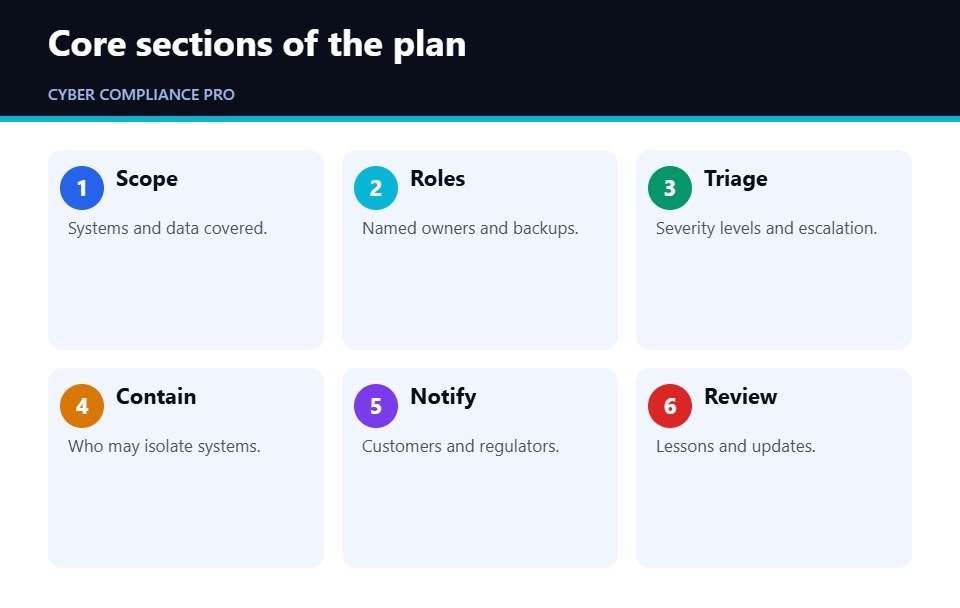
A usable plan is short enough to read during a crisis and specific enough to act on. These nine sections cover what most Australian organisations need.
- Purpose and scope: Which systems, data and sites the plan covers.
- Roles and contacts: Named people, backups and out-of-hours numbers.
- Severity levels: A simple scale that tells staff when to escalate.
- Detection and triage: How an alert becomes a confirmed incident.
- Containment steps: Who may isolate systems, and how.
- Communication plan: Internal updates, customers, regulators and media.
- Evidence handling: What to preserve and who may access it.
- Recovery steps: The order for restoring systems and confirming they are clean.
- Review process: Lessons learned and plan updates after each event.
As a rule, keep each section to a page where possible. Long narrative text is hard to follow when people are stressed.
Roles and Decision Rights
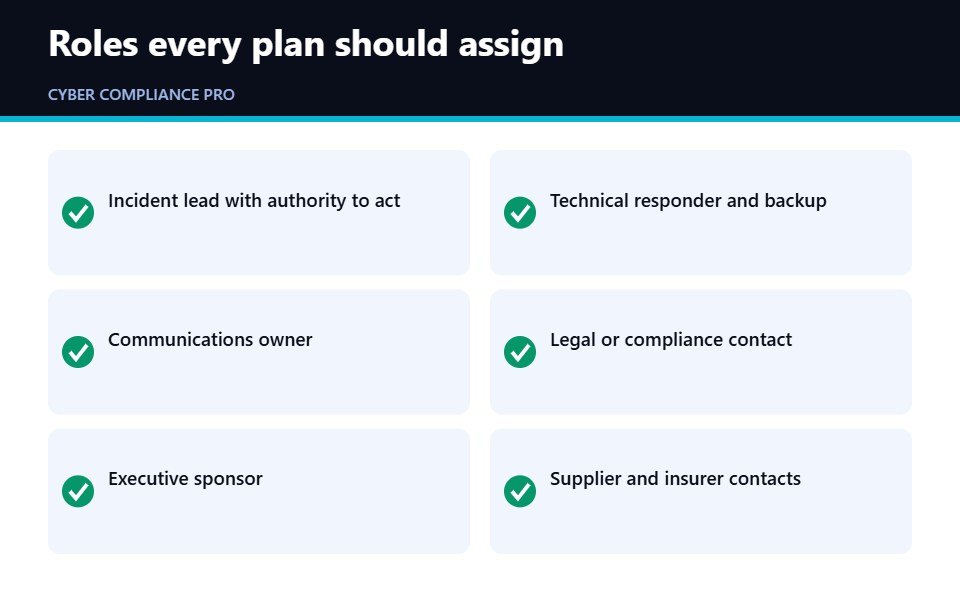
Most plans fail on decisions, not technology. Someone must be authorised to take a system offline, and someone else must decide when to tell customers.
For that reason, write these decision rights down. A typical team includes an incident lead, a technical responder, a communications owner, a legal or compliance contact and an executive sponsor. Smaller organisations often combine roles, which is fine as long as every task has a named owner and a backup.
Prefer expert support? Our cyber incident response plan and procedure service builds and tests the plan with you.
Aligning the Plan With ACSC Guidance and Reporting Duties
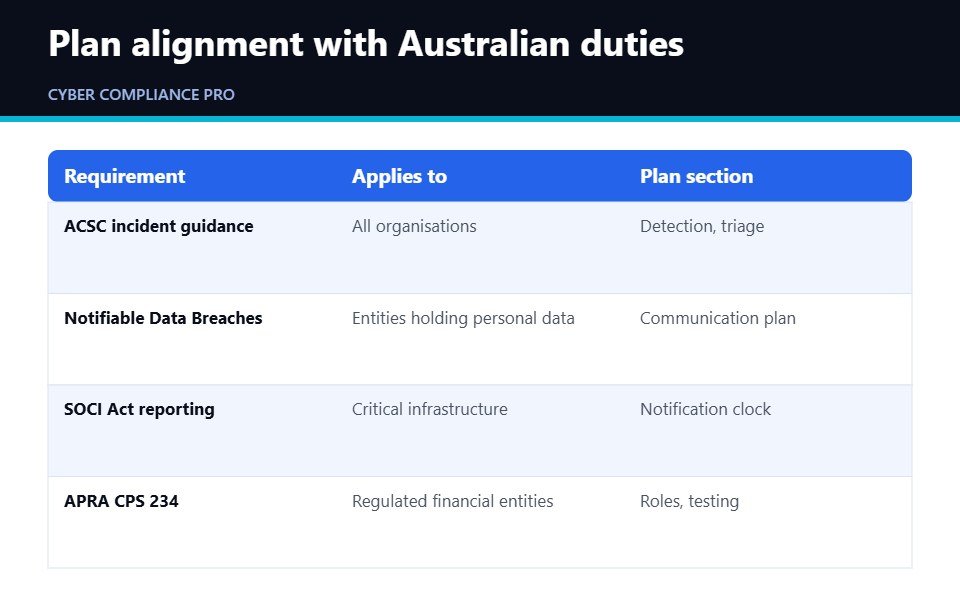
Australian organisations should check the plan against the Australian Cyber Security Centre advice on preparing for and responding to incidents. The ACSC also accepts cybercrime and incident reports, and some critical infrastructure owners have mandatory reporting duties under the SOCI Act.
If you hold personal information, the Notifiable Data Breaches scheme requires you to assess suspected breaches quickly and notify affected people and the OAIC when serious harm is likely. Build that assessment step, with a clock, directly into the template so nobody has to remember it under stress.
Regulated entities should also check sector rules, such as APRA CPS 234 for financial services, which sets expectations for incident management and notification.
Testing and Maintaining the Plan
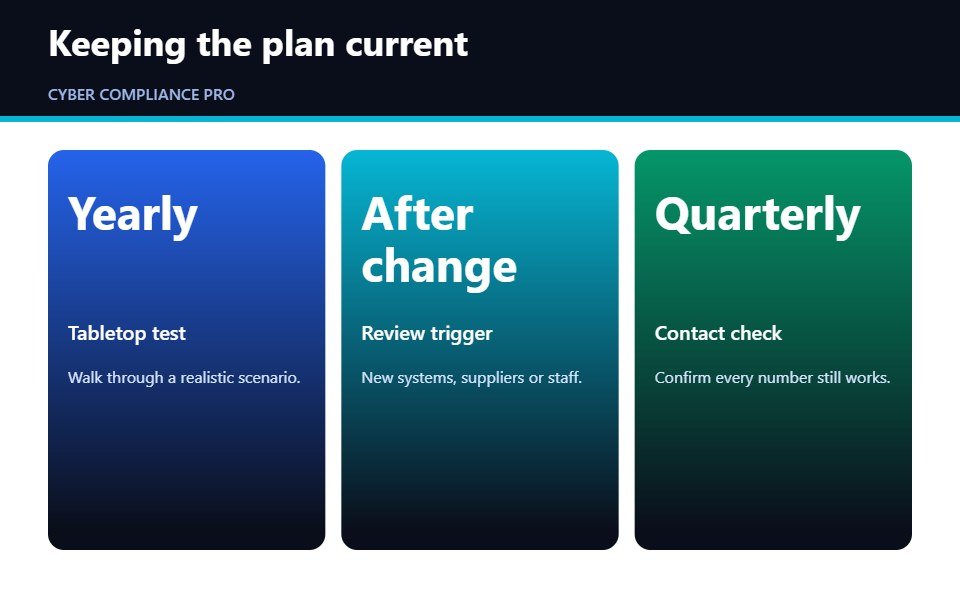
An untested plan is a guess. Run a tabletop exercise at least once a year, where the team walks through a realistic scenario such as ransomware or a compromised email account. Treat the cyber incident response plan template as a living document rather than a one-off task.
During the exercise, look for gaps in contact lists, unclear authority and missing backup communication channels. Then update the document and record the changes. Review the plan sooner if you change major systems, suppliers or key staff.
Many teams find that a short checklist for the first hour sits well on a single page at the front of the plan. It gives responders a clear starting point without reading the whole document.
Common Template Mistakes to Avoid
A downloaded cyber incident response plan template often contains placeholder text that never gets replaced, generic contact lists and steps that assume tools you do not own. Replace every placeholder before you rely on the document.
Another frequent problem, however, is storing the plan only on the network it is meant to protect. If ransomware locks your files, nobody can open the plan. Keep an offline or separately hosted copy, and make sure the incident lead can reach it from a personal device.
Finally, link the plan to your wider governance. Your cyber compliance assessment should confirm that the plan exists, is current and has been tested.
Need a response plan built around your actual systems and obligations?
Get in TouchFrequently Asked Questions
It is a pre-built document structure listing the sections a response plan needs, such as roles, severity levels, containment steps and communications. You adapt it with your own systems, contacts and decision rights.
Short enough to use in a crisis. Many effective plans run to ten or fewer pages, with a one-page first-hour checklist at the front.
Not for every organisation, but the Notifiable Data Breaches scheme, the SOCI Act and sector rules such as APRA CPS 234 create duties that a plan helps you meet.
At least once a year through a tabletop exercise, and again after major changes to systems, suppliers or key staff.
Keep at least one offline or separately hosted copy so it stays reachable if your main network is unavailable.