
ISO 27001 Certification Process: Steps and Timeline
The ISO 27001 certification process has a clear order: scope, risk, controls, internal audit and two external audit stages. This guide walks through each step and gives a realistic timeline for Australian organisations.
Nine Steps to Certification
From scope to the Stage 2 audit, in plain language.
Read SectionQuick answer: The ISO 27001 certification process has nine steps: set the scope, run a gap analysis, assess risk, write the statement of applicability, implement controls, run an internal audit, hold a management review, then pass the Stage 1 and Stage 2 audits. Many organisations plan three to twelve months.
The ISO 27001 certification process looks long on paper, but it follows a simple logic. You decide what is in scope, assess risk, put controls in place, check your own work and then invite an accredited auditor to confirm it. First, though, you need to know the order.
This guide explains each step and what auditors expect. It also links to the cost and internal audit guides, so you can plan budget and preparation together. For our own support on this journey, see ISO 27001 certification support.
The ISO 27001 Certification Process in Nine Steps

- Set the scope. Decide which sites, systems, teams and suppliers the system covers.
- Run a gap analysis. Compare what you do today with the standard.
- Assess risk. Identify risks to information and choose how to treat each one.
- Write the statement of applicability. List which Annex A controls apply, and why.
- Implement controls. Write policies, fix technical gaps and train staff.
- Run an internal audit. Test your own system. See our guide on how to run an ISO 27001 internal audit.
- Hold a management review. Leaders review results and approve improvements.
- Pass the Stage 1 audit. The auditor reviews your documents and readiness.
- Pass the Stage 2 audit. The auditor checks that controls work in practice.
Each step produces records. Keep them, because auditors will ask to see them.
It also helps to agree evidence early. For example, keep access review records, training logs, supplier assessments and backup test results in one shared folder, labelled by control. Then, when the auditor asks, you can answer in minutes rather than days.
Choosing a Certification Body
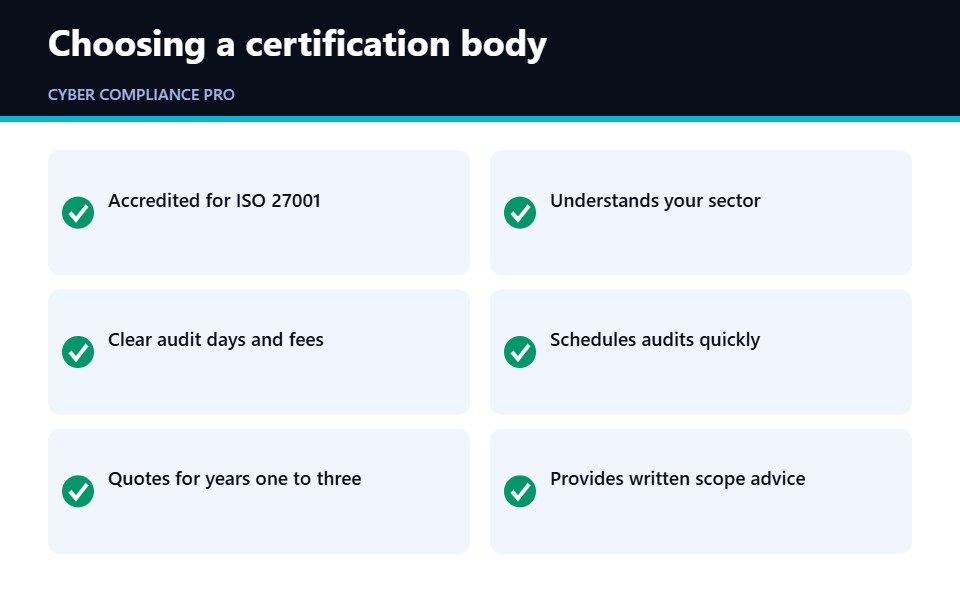
Next, choose an accredited certification body. In Australia, JAS-ANZ accredits these bodies, and accreditation gives your certificate wider recognition. Ask each body how it calculates audit days, what the surveillance audits cost and whether it audits your sector.
- Is the body accredited for ISO 27001?
- Does it understand your industry?
- What are the audit days and fees for years one to three?
- How soon can it schedule Stage 1 and Stage 2?
Request written quotes from at least two bodies, using the same scope.
Not sure where you stand today? A cyber compliance assessment gives you a gap list and a priority order before you start.
ISO 27001 Certification Process Timeline

Timelines vary with size and starting point. As a guide, many organisations plan between three and twelve months from the first gap analysis to a certificate. Smaller, well-organised teams sit at the short end.
The table above shows a typical split of effort. However, the biggest delays usually come from three places: unclear scope, slow fixes to technical gaps and a late internal audit.
What Slows Teams Down
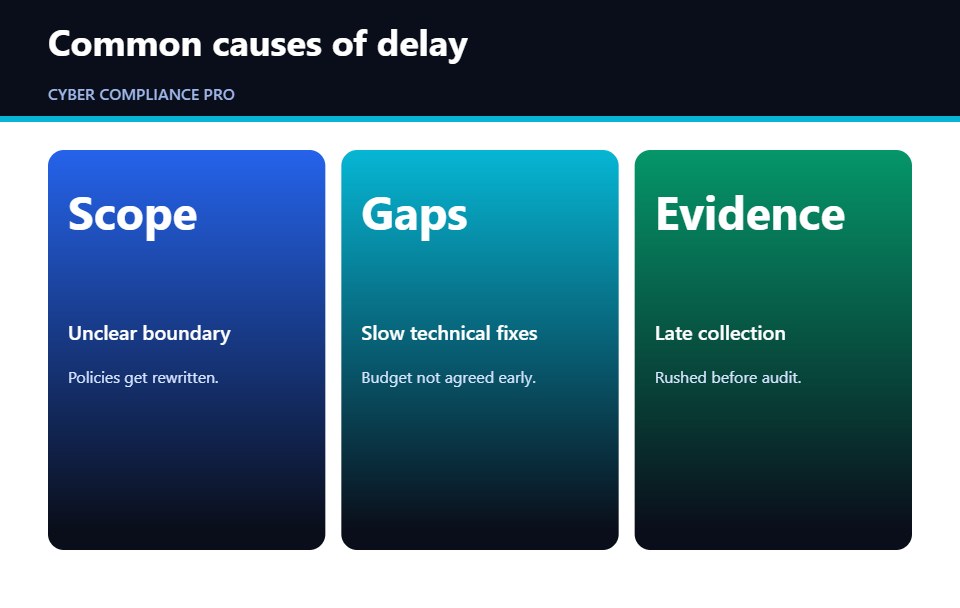
Most delays are avoidable. For example, teams often start writing policies before agreeing the scope, so they rewrite them later. Others leave evidence collection until the week before the audit.
To stay on track, name one internal owner, set a weekly check-in and book the audit dates early. Also, read our guide to ISO 27001 certification cost in Australia so the budget is agreed before work begins.
Finally, keep leadership involved. Certification needs resources and approval, so brief the sponsor monthly and show progress against the nine steps.
After Certification: Surveillance and Renewal
The certificate lasts three years. During that time, the auditor returns for surveillance audits, usually once a year. After three years, a recertification audit renews it.
Therefore, treat certification as a cycle rather than a finish line. Keep running internal audits, update the risk register and record management reviews. A ISO 27001 risk register template makes the ongoing risk work easier.
ISO 27001 Certification Process: The Short Version
The ISO 27001 certification process has six stages: define your scope, run a risk assessment, implement controls, complete an internal audit and management review, pass the Stage 1 and Stage 2 audits with an accredited certification body, then maintain the system through annual surveillance audits.
- Scope: decide which people, systems and locations the ISMS covers.
- Risk assessment: identify risks and record your control choices in the Statement of Applicability.
- Implementation: put policies, controls and evidence in place.
- Internal audit and management review: both must happen before the certification audit.
- Stage 1 and Stage 2: the auditor reviews your documents, then tests that controls work in practice.
- Certification and surveillance: the certificate runs for three years, with audits in between.
Most organisations get stuck at step four, so read how to run an ISO 27001 internal audit early, and compare the budget in our ISO 27001 certification cost guide. For support through each stage, see our cybersecurity compliance consulting services.
Want a clear plan and timeline for ISO 27001 certification?
Get in TouchRelated resources
Once the scope is set, the ISO 27001 certification page explains how we support each stage. The security policy templates give you drafts for the documents an auditor expects, and the internal audit checklist helps you test the system before Stage 1.
Frequently Asked Questions
The mandatory documents include the scope, the information security policy, the risk assessment and risk treatment process, the Statement of Applicability, security objectives, and records such as the internal audit report and management review minutes. You also need the policies and procedures your risk assessment shows are necessary, with evidence they are followed.
Many organisations plan three to twelve months, depending on size, scope and starting maturity.
Stage 1 reviews your documents and readiness. Stage 2 tests that your controls work in practice.
No, but many teams use one for the gap analysis and audit preparation.
Three years, with surveillance audits in between and a recertification audit at the end.
An accredited certification body. JAS-ANZ accredits these bodies.
Two initial audits: Stage 1 reviews your documentation and readiness, and Stage 2 tests whether controls work in practice. After certification, surveillance audits follow each year of the three-year cycle.