Essential Eight Changes 2026: What ASD's Retirement Plan Means for Your Compliance Program
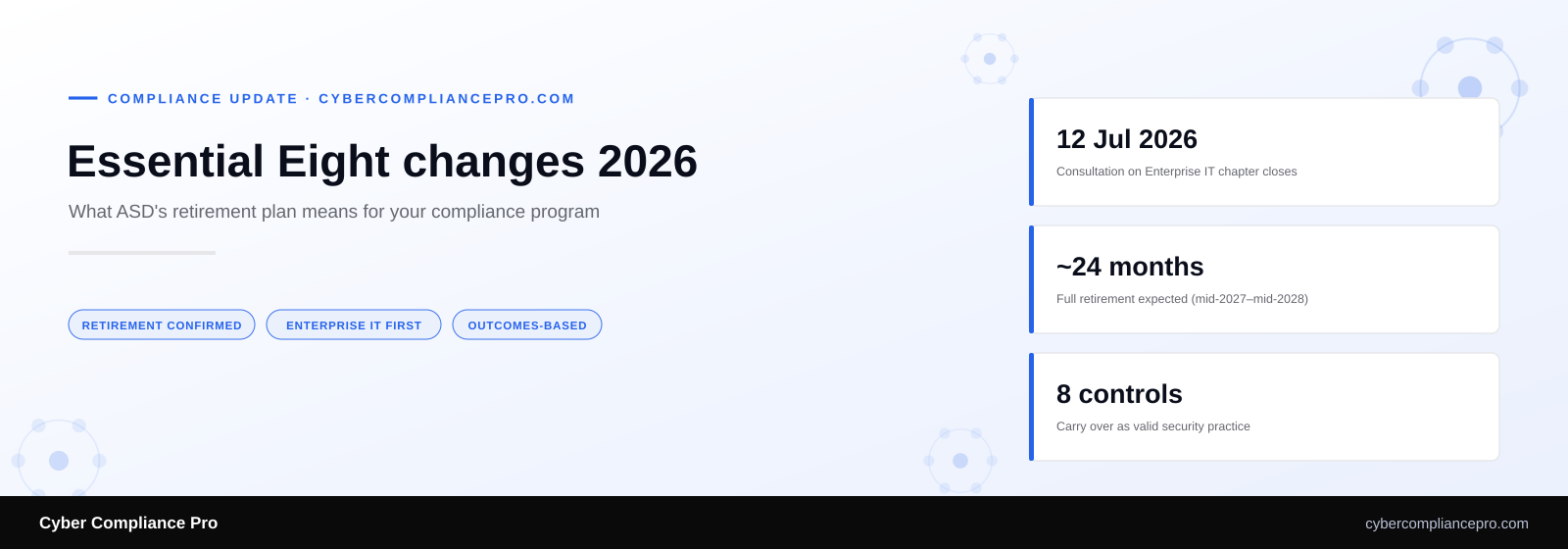
The Australian Signals Directorate has confirmed the Essential Eight is being retired. In its place: a new domain-specific framework called Essentials, built around outcomes rather than a fixed checklist. If your organisation has spent the past few years working toward Maturity Level Two, the obvious question is whether that effort still counts — and what actually changes between now and full retirement.
The Transition Timeline
When Essential Eight actually gets deprecated, and what's still being decided.
Read SectionWhat Doesn't Change (Yet)
The eight core controls, DISP obligations, and existing contracts stay put — for now.
Read SectionWhat to Do Now
The practical moves to make between today and full retirement.
Read SectionWhat ASD Announced
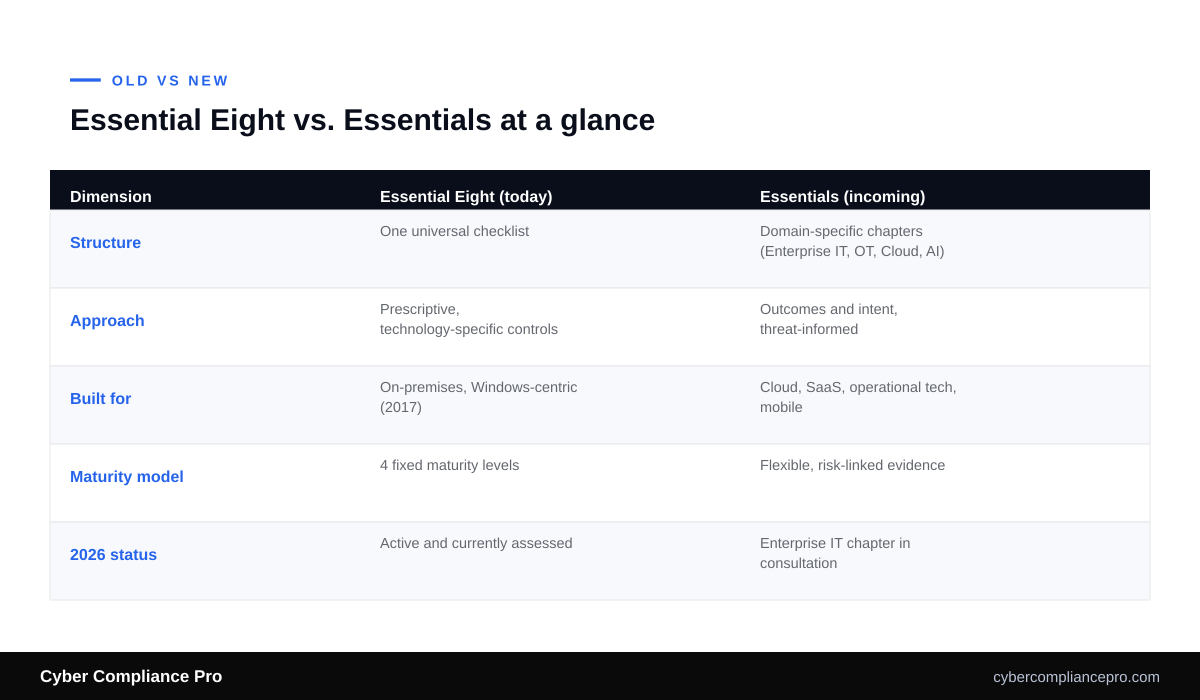
ASD is phasing out the Essential Eight and replacing it with a series of framework chapters collectively called Essentials. Rather than one checklist applied uniformly across every environment, Essentials is split by domain: Enterprise IT is first out of the gate, followed by Operational Technology and Cloud, with a chapter for agentic AI flagged as a possibility down the track.
The bigger shift isn't the naming — it's the structure. The Essential Eight gave organisations eight specific technical controls and four maturity levels to hit. Essentials moves toward outcomes and intent: threat-informed guidance that tells you what risk you're managing and why, leaving more room for how you actually implement it. For a mid-sized business running a mix of on-premises servers, SaaS platforms and cloud infrastructure, that flexibility is likely welcome. It also means audits and assessments will start asking different questions — less "did you tick this control," more "can you show this control addresses a real risk in your environment."
The Timeline for Essential Eight Changes in 2026
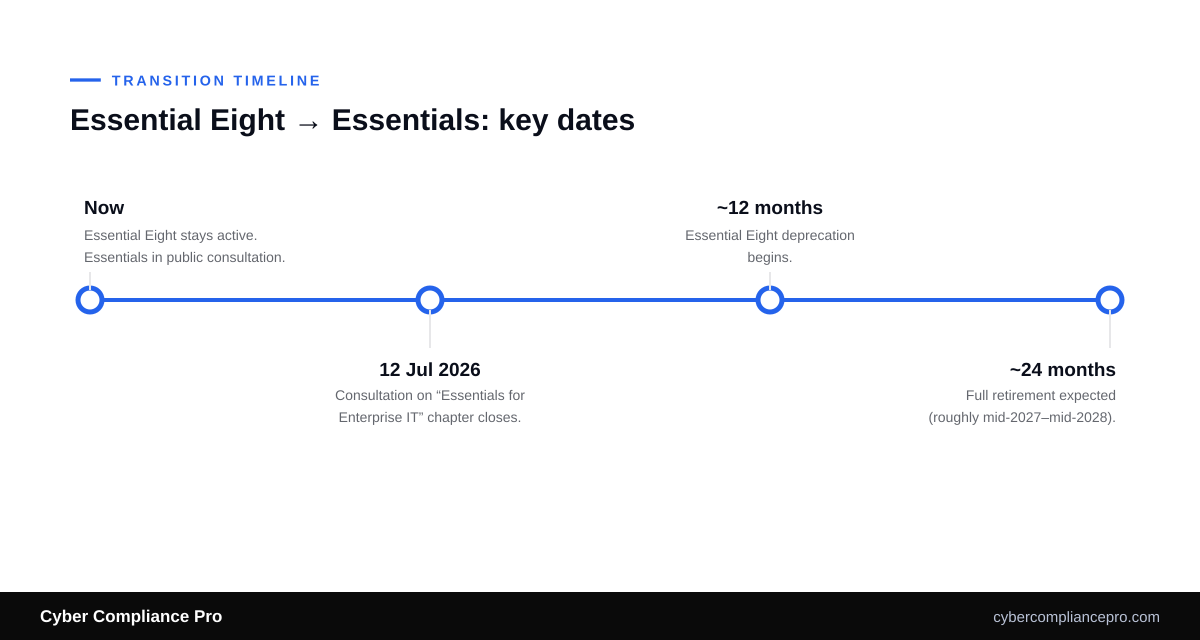
Nothing about this happens overnight. Essential Eight and Essentials will run in parallel for a period before any formal deprecation begins. Public consultation on the first chapter — Essentials for Enterprise IT — closes 12 July 2026, and ASD has said it will factor that feedback into the final published guidance.
From there, deprecation of the Essential Eight is expected to begin around the 12-month mark, with full retirement landing somewhere in the 24-month range — sources close to the consultation put that at roughly mid-2027 through mid-2028, though ASD has been clear these dates aren't locked in and may move depending on what comes out of the consultation process. The practical takeaway: you have time, but not an indefinite runway, and the shape of the replacement framework is still being finalised.
What Doesn't Change (Yet)
The eight controls themselves — patching applications, patching operating systems, multi-factor authentication, restricting administrative privileges, application control, restricting Microsoft Office macros, user application hardening and regular backups — remain valid security practice regardless of what the framework is called. ASD has been explicit that work done under the Essential Eight will map across to Essentials, not get discarded. As ASD's Chris Horlyck put it, the investment organisations have made under the Essential Eight will still be relevant under the Essentials.
A few things also stay fixed during the transition. Essential Eight Maturity Level Two remains mandatory for Defence Industry Security Program membership for now, and existing regulatory references or contractual clauses that cite the Essential Eight haven't changed. If a client contract or a government tender currently specifies an Essential Eight maturity level, that requirement still stands until told otherwise.
Not sure where your organisation actually stands today? Cyber Compliance Pro's Essential Eight self-assessment gives you a baseline before you commit further budget in either direction — and it maps cleanly onto whatever the Essentials guidance eventually asks for.
What to Do Between Now and Retirement

The worst response to this announcement is inertia — either stopping work because "it's going away anyway," or scrambling to overhaul everything before the replacement framework even exists. Neither is warranted yet. A more useful approach:
- Keep maturing against the Essential Eight now. It's still the active, assessed standard, and your current uplift work isn't wasted effort — it's the foundation the Essentials guidance is being built to recognise.
- Document controls as risk-linked evidence, not checklist entries. If you can already show why a control exists — which threat it addresses, what asset it protects — you're ahead of where Essentials assessments are heading.
- Map your cloud and shared-responsibility obligations now. Cloud is one of the confirmed Essentials chapters, and it's an area most organisations haven't documented cleanly under the Essential Eight's largely on-premises framing.
- Watch the consultation if you're regulated under PSPF, the SOCI Act, or APRA. Those regimes are likely to reference the new guidance directly once it's finalised.
- Hold off on panic-buying new tooling. Vendors are already marketing "Essentials-ready" products; none of that matters until the enterprise IT chapter is locked in.
Where you want a properly mapped view of your current posture rather than a guess, a maturity assessment is the practical way to get that done, and it pairs well with broader certification and compliance readiness work if you're also tracking toward ISO 27001 or IRAP obligations alongside Essential Eight.
Why ASD Is Making the Change
The original Essential Eight was published in 2017, written for an environment that was largely Windows-based and on-premises. Nine years on, most organisations run a mix of SaaS, cloud infrastructure, remote endpoints and, increasingly, operational technology — none of which the original framework was built to address directly. A single checklist stretched across all of that starts to produce gaps: controls that technically apply but don't map cleanly to where the actual risk sits, and shared-responsibility questions the Essential Eight was never designed to answer. Essentials is ASD's attempt to fix that by building guidance around each environment rather than forcing every environment through the same eight boxes.
Getting Ready for the Transition
Retirement of the Essential Eight is confirmed, but the practical impact between now and 2028 is manageable if you treat it as a planning exercise rather than a scramble. The organisations that come out ahead will be the ones who keep maturing now, document their reasoning, and adjust as the Essentials chapters are finalised — not the ones who wait for a final framework before doing anything.
Have questions about how this timeline applies to your specific setup? Get in touch with our team or call us now on +61 3 8686 9159 (Mon–Sat, 8am–5pm AEST) and we'll walk through your current maturity level against it.
To see where you stand today, a cyber compliance assessment is the fastest baseline, and our cybersecurity compliance consulting team can map the results to the new framework.
To see where you stand against these controls, learn how to run a cyber compliance assessment.
To measure where you stand against these changes, book an Essential Eight assessment.
Ready to find out where you actually stand against the Essential Eight?
Book a Readiness CallFrequently Asked Questions
No. Essential Eight and Essentials will run in parallel first; deprecation is expected to begin around 12 months after ASD's announcement, with full retirement in the roughly 24-month range (mid-2027 through mid-2028), and these dates may still shift based on consultation feedback.
Yes. ASD has said work done under the Essential Eight will map across to Essentials rather than being discarded — the eight core controls remain valid security practice regardless of the framework's name.
A new domain-specific series called Essentials, starting with an Enterprise IT chapter, followed by Operational Technology and Cloud, with agentic AI flagged as a possible future addition.
Yes, for now — Essential Eight Maturity Level Two remains mandatory for Defence Industry Security Program membership during the transition period.
No. ASD and industry guidance both recommend continuing to mature against the Essential Eight now, since that work carries forward and pausing only leaves gaps to close later.
Consultation on the "Essentials for Enterprise IT" chapter closes 12 July 2026, with ASD incorporating feedback into the final published guidance.