Right Fit for Risk (RFFR): What It Is and How to Prepare
Right Fit for Risk is the Department of Employment and Workplace Relations scheme that sizes security obligations to the risk each provider carries. This guide explains what it asks for, how the categories differ and how to prepare for accreditation.
Quick answer: Right Fit for Risk (RFFR) is a Department of Employment and Workplace Relations scheme that matches security requirements to the risk each provider carries. Larger providers in Category One are expected to run a certified ISO 27001 system, smaller providers follow a lighter Category Two pathway, and every provider works through three milestones.
Right Fit for Risk, usually shortened to RFFR, is a Department of Employment and Workplace Relations scheme for organisations that deliver employment and skills services under its contracts. In short, it matches security requirements to the risk each provider carries. First, it helps to understand the idea behind it.
A small community provider and a national network do not hold the same amount of personal information. Therefore, the scheme scales obligations to your caseload and the sensitivity of the data you handle. Our Right Fit for Risk accreditation service supports providers through the process.
What Right Fit for Risk Asks of Providers
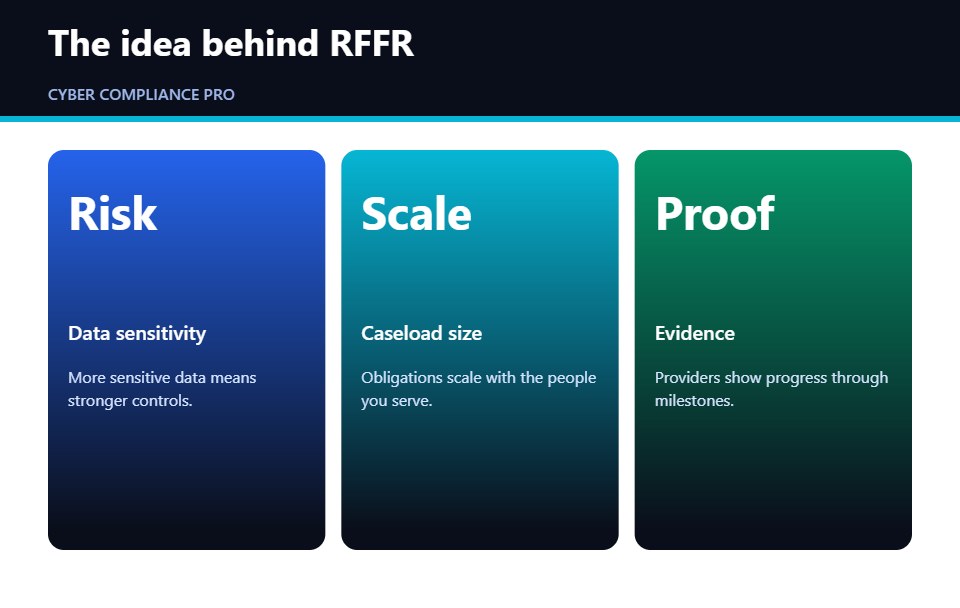
The scheme is built on a simple principle. The more sensitive information you hold, and the more people you serve, the stronger your controls must be. Providers therefore decide which category applies, then work through milestones to show they meet it.
The Department of Employment and Workplace Relations publishes the current requirements and contract terms, so always confirm details with your contract manager.
It also helps to think about who inside your organisation owns the work. Typically, a senior manager sponsors the program, a security lead runs it day to day, and operations staff supply the evidence. Because the scheme spans several teams, agree those roles at the start.
Right Fit for Risk Categories One and Two
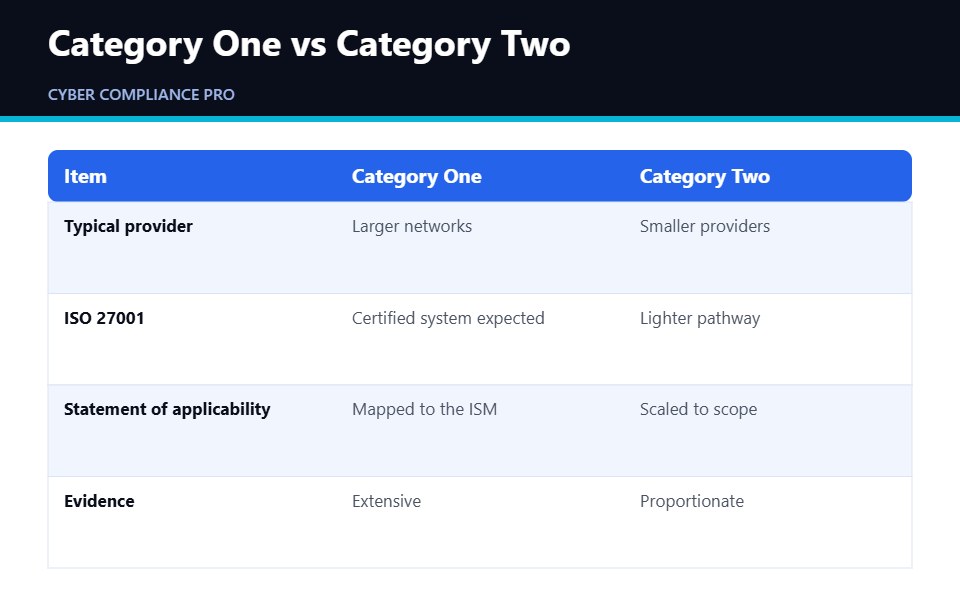
Larger providers sit in Category One. They are expected to run a certified ISO 27001 management system, with a statement of applicability that maps controls to the Australian Government Information Security Manual. Smaller providers follow the Category Two pathway, which is lighter but still requires evidence of sensible controls.
Because the category drives cost and effort, decide it early. If you are close to the boundary, check your caseload numbers and the data you hold before you plan the work.
Finally, remember that obligations can shift if your caseload or data changes. Review your category each year so the plan stays aligned with the contract.
Need help with the milestones? Our RFFR accreditation support covers the category decision, the statement of applicability and the submissions.
The Three Milestones
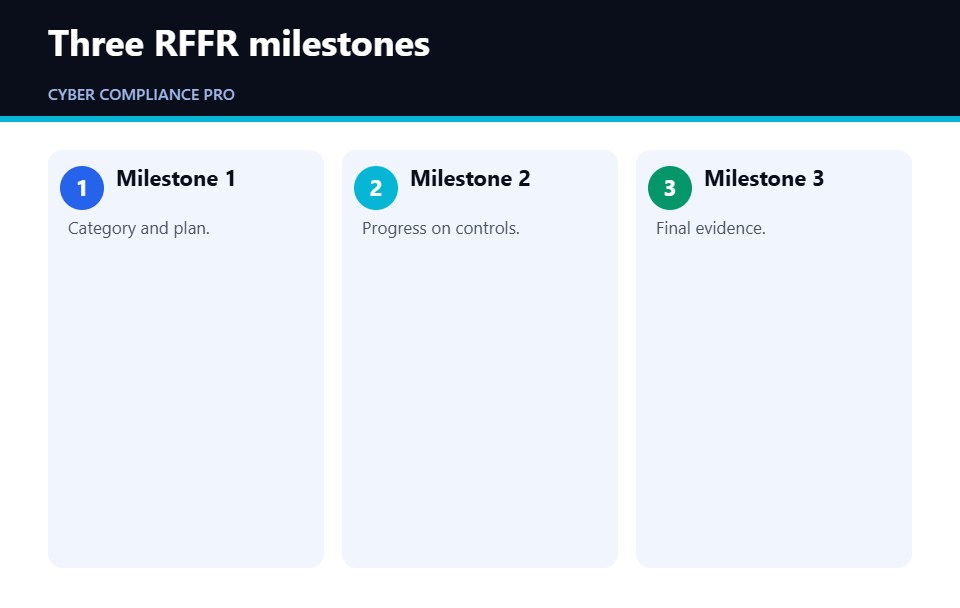
Providers work through three milestones. Each one asks you to submit evidence that your security work is moving forward.
- Milestone 1. Confirm your category and show you have started planning and scoping.
- Milestone 2. Show progress on controls, policies and the statement of applicability.
- Milestone 3. Provide the final evidence that the required controls are in place.
Check the exact dates and wording in your contract, because submission details can change.
How to Prepare for Right Fit for Risk Accreditation
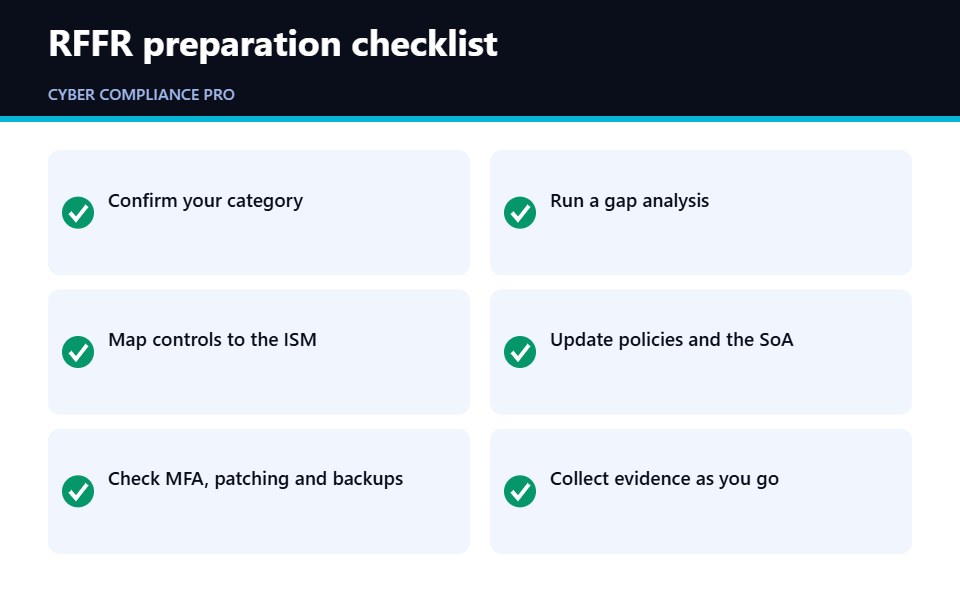
Start with the basics. First, confirm your category. Then run a gap analysis against the controls that apply, and list what you must fix.
- Map your current controls to the Information Security Manual.
- Write or update your policies and your statement of applicability.
- Check multi-factor authentication, patching, backups and access reviews.
- Collect evidence as you go, rather than at the deadline.
- Assign one owner and a weekly check-in.
If Category One applies, our guide to the ISO 27001 certification process shows the steps and timeline, and our Essential Eight assessment covers many of the technical controls.
Common Mistakes to Avoid
Providers often underestimate the evidence required. For example, they write policies but cannot show that staff followed them. Others leave the statement of applicability until the end, so decisions about controls come too late.
Also, do not treat the scheme as a one-off project. Privacy duties continue, so link the work to your privacy risk and compliance practices. Review controls regularly, and keep records that show you did. If you want help preparing, our cybersecurity compliance consulting team can support the whole process.
Delivering DEWR services? Get your RFFR plan and milestones mapped.
Get in TouchRelated resources
Preparation goes faster with the right documents in place. Use the ISO 27001 risk register template for the risk assessment, the security policy templates for the policy set, and see how an ISO 27001 certified system can supply much of the evidence assessors ask for.
Frequently Asked Questions
Expect to show approved policies, a risk register and risk treatment plan, a Statement of Applicability mapped to the required controls, and records that the controls operate: access reviews, patch and backup reports, training logs and incident response testing. Collecting these as you go makes each milestone submission easier.
It depends on your category and your starting point. A provider that already has policies, a risk register and tested controls can move quickly, while one starting from scratch should plan several months to build the system and gather evidence before the final milestone. A gap assessment against your category gives a realistic timeline.
It is a Department of Employment and Workplace Relations scheme that scales security requirements to each provider's risk.
Organisations that deliver employment and skills services under DEWR contracts.
Category One providers are expected to hold a certified ISO 27001 system. Category Two follows a lighter pathway.
Three. Each requires evidence that your security work is progressing.
Larger providers in Category One generally do. Check your category and contract for the exact requirement.