
ISO 22301 Explained: Business Continuity Certification
ISO 22301 is the international standard for business continuity management. This guide explains what it requires, how certification works and why many Australian organisations use it to show they can keep operating through disruption.
What the Standard Requires
The seven clauses in plain language, from context to improvement.
Read SectionQuick answer: ISO 22301 is the international standard for business continuity management systems. Certification involves a Stage 1 document review, a Stage 2 practical audit, yearly surveillance audits and a recertification audit at the end of a three-year cycle.
ISO 22301 sets out the requirements for a business continuity management system. In simple terms, it describes how an organisation plans for disruption, responds when it happens and keeps improving afterwards. As a result, certification shows customers and regulators that the work is real and audited.
First, this guide covers the main requirements, the certification steps and how the standard sits alongside other frameworks. For the practical planning side, see our guide to writing a business continuity plan.
What ISO 22301 Requires, Clause by Clause
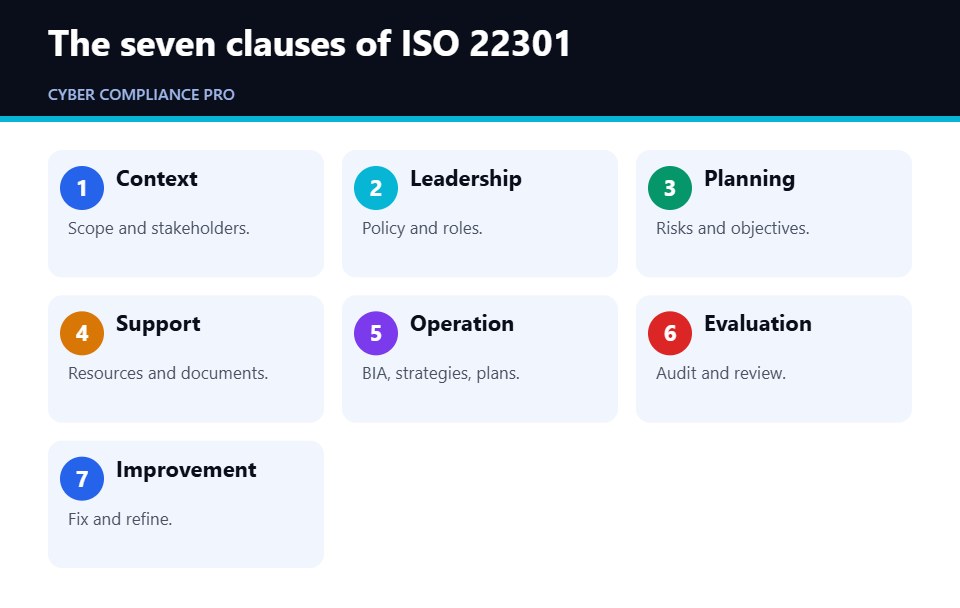
Like other modern management standards, ISO 22301 follows seven main clauses. However, they are easier to follow when you see them as a cycle.
- Context. Understand your organisation, its stakeholders and the scope of the system.
- Leadership. Leaders set the policy, assign roles and back the programme.
- Planning. Identify risks and opportunities, and set continuity objectives.
- Support. Provide resources, skills, awareness and controlled documents.
- Operation. Run a business impact analysis, choose strategies and write plans.
- Performance evaluation. Monitor, audit internally and hold management reviews.
- Improvement. Fix nonconformities and keep getting better.
Also, the operation clause carries most of the practical work. It includes the business impact analysis and the exercises that test your plans.
How ISO 22301 Certification Works

Certification follows the same path as other management system standards. First, you build the system and run an internal audit. Next, an accredited certification body carries out a two-stage audit.
- Stage 1: The auditor reviews your documents and checks readiness.
- Stage 2: The auditor tests that the system works in practice, using records and interviews.
- Surveillance audits: Short reviews in the following years.
- Recertification: A full audit at the end of the three-year cycle.
The international standard page lists the current edition. Your certification body can then confirm which version applies.
Auditors usually ask for evidence that you ran the business impact analysis, tested the plans and acted on what you found. Therefore, keep exercise reports, review minutes and corrective action records together in one folder.
Thinking about certification? Our business continuity and resilience services cover gap analysis, plans and exercises aligned to ISO 22301.
ISO 22301 Compared With ISO 27001 and CPS 230

The continuity standard and ISO 27001 use the same management system structure, so organisations often run them together. ISO 27001 protects information. By contrast, its continuity sibling keeps the business running when something goes wrong.
Then there is regulation. For regulated financial entities, APRA CPS 230 sets expectations for operational risk and business continuity. Certification is not a legal requirement under CPS 230. However, it gives a recognised structure for meeting many of its expectations.
Benefits and Costs to Expect

The main benefits are practical. You get tested plans, clearer roles, stronger tender responses and a shared language with customers. Also, many buyers now ask suppliers how they would continue service during an outage.
Because every organisation differs, the effort depends on scope and starting point. A small organisation with documented processes can move quickly. Others need time to run the analysis, write plans and complete at least one exercise before the audit.
Plan for internal time as well as audit fees. After all, staff will attend workshops, review plans and take part in exercises, so schedule that work early.
Is ISO 22301 Right for You?
It suits organisations where downtime is costly or contractually sensitive, such as technology providers, financial services and critical suppliers. However, if your needs are smaller, a well-tested plan may be enough for now.
First, start with a gap check against the clauses. A cyber compliance assessment can then show how your continuity and security work fit together before you commit to certification. If you need a partner for the project, our cybersecurity compliance consulting work covers continuity planning as well.
Want to know whether ISO 22301 fits your organisation?
Get in TouchRelated resources
ISO 22301 works best alongside your wider risk work. Link the continuity plan to your risk register, make sure it lines up with your incident response plan, and see how it fits with ISO 27001 certification if you are pursuing both. ISO 22301 expects a documented plan. Our business continuity plan template shows what to put in it.
Frequently Asked Questions
Yes. Both standards use the same management system structure, so many organisations run one combined audit with a single certification body. The documents for leadership, internal audit, management review and corrective action are shared, which reduces duplicated effort and cost.
It is the international standard for business continuity management systems.
No. It is voluntary, although customers and regulators may expect similar practices.
It varies with scope and maturity. Many organisations plan several months from gap analysis to the audit.
One covers continuity of operations. The other covers information security.
No. The plan sits inside the management system that the standard describes.