
Business Continuity Plan Template: What to Include
A business continuity plan template saves time only if it is filled in with real names, systems and targets. This guide gives you a ten-section outline and a sample page you can copy for each critical service.
Ten Sections to Include
A simple structure that covers response, recovery and communication.
Read SectionQuick answer: A business continuity plan template has ten sections: purpose and scope, critical services, recovery targets, activation, roles and contacts, recovery steps, communications, supplier dependencies, a testing schedule and version control. Fill each with your own people, systems and targets.
A business continuity plan template gives you the headings and structure, so you can spend your time on the content that matters. However, a template is only a starting point. It becomes a plan once you add your own critical services, recovery targets and contacts.
Below is a practical outline you can copy into any document. If you want the step-by-step method first, read our guide on how to write a business continuity plan.
Business Continuity Plan Template: The Ten Sections
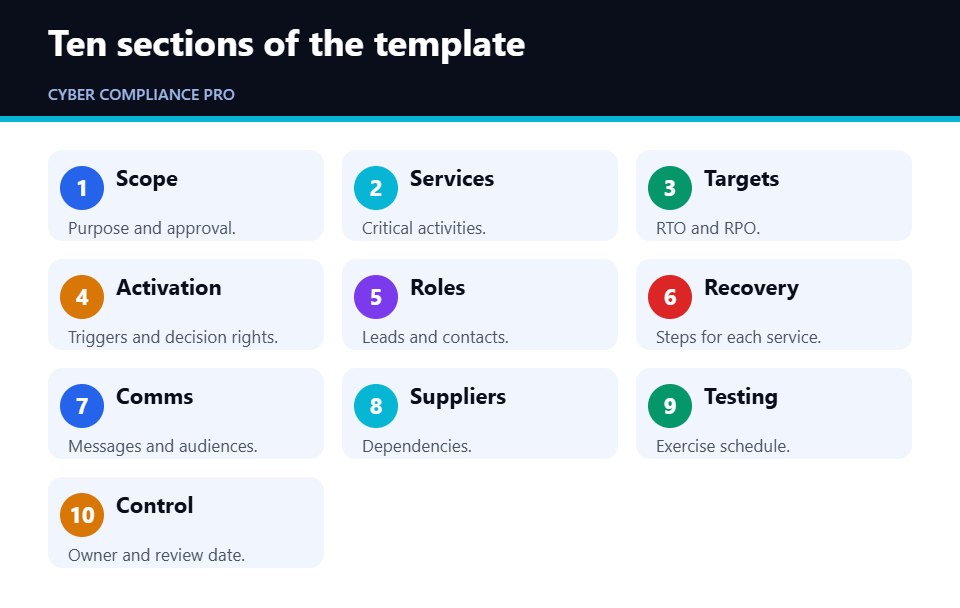
- Purpose and scope. What the plan covers, and who approved it.
- Critical services. The activities that must keep running.
- Impact and targets. Recovery time and recovery point objectives for each service.
- Activation. What triggers the plan and who can declare an incident.
- Roles and contacts. Named leads, backups and out-of-hours numbers.
- Recovery steps. What to do for people, premises, technology and suppliers.
- Communications. Messages for staff, customers, regulators and the media.
- Supplier dependencies. Who you rely on, and what they have promised.
- Testing schedule. When you will run exercises and review the plan.
- Version control. Owner, approval date and review date.
Keep each section to a page where possible. Long text is hard to follow under stress.
A Sample Page for One Critical Service
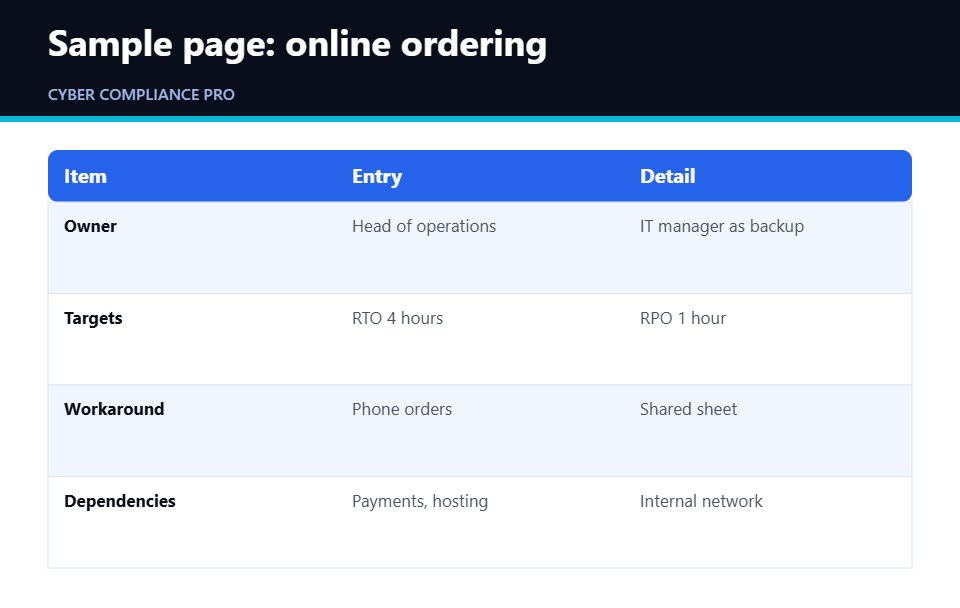
Repeat the same page for every critical service. That way, people always know where to look. Here is an example for an online ordering system:
- Service owner: Head of operations, with the IT manager as backup.
- Recovery time objective: Four hours. Recovery point objective: One hour of data.
- First-hour actions: Confirm the outage, switch to the backup site and tell the support team.
- Workaround: Take orders by phone and record them on a shared sheet.
- Dependencies: Payment provider, hosting provider and the internal network.
- Communications: Customer notice within thirty minutes, then hourly updates.
Because every service uses the same layout, new team members learn the format once and can read any page.
Prefer expert help? Our business continuity and resilience services turn the outline into a plan that is tested with your team.
Contact and Supplier Tables Worth Adding
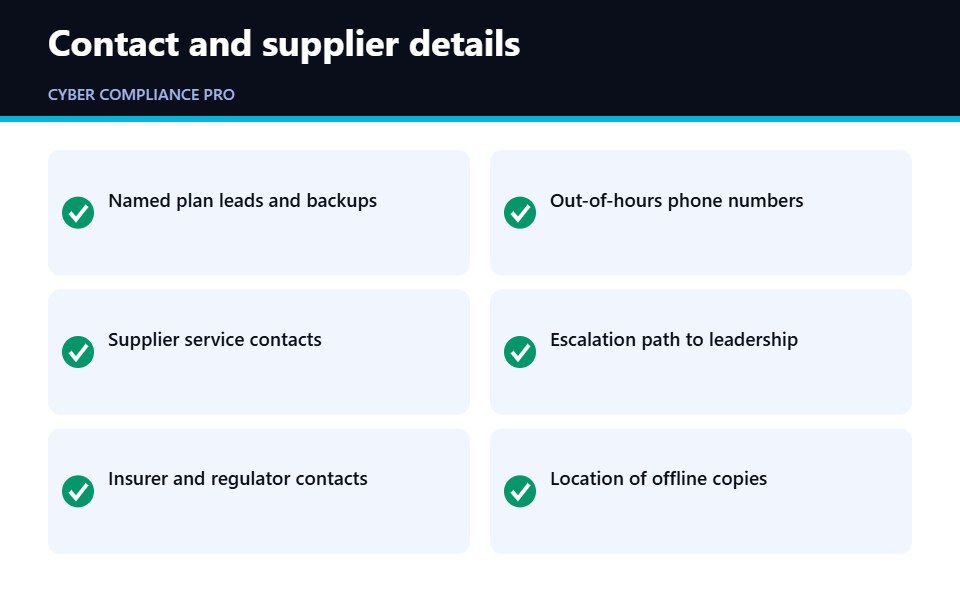
Two tables make the plan far more useful. The first lists every person with a role in the plan, including a phone number that works out of hours. The second lists suppliers, the service they provide and how to reach them during an incident.
Also add the location of offline copies. If ransomware locks your network, nobody can open a plan that lives only on a shared drive.
A short glossary helps too. Define terms such as recovery time objective, recovery point objective and activation in one paragraph, so every reader means the same thing when the plan is used.
How to Adapt Any Business Continuity Plan Template
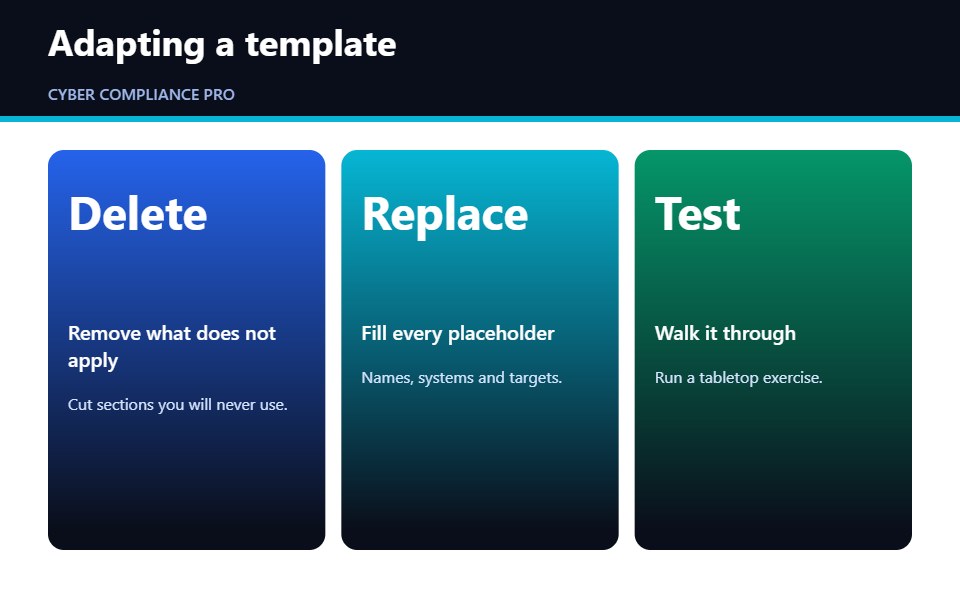
First, delete sections that do not apply, and replace every placeholder. Then check each statement against reality. If the template says "all staff can work remotely" and they cannot, change the plan or fix the gap.
Finally, test it. A tabletop exercise reveals missing steps quickly. The Australian Prudential Regulation Authority also sets continuity expectations for regulated entities, so check sector rules where they apply.
Common Template Mistakes
Downloaded templates often keep generic wording, such as "key personnel" and "critical systems". As a result, nobody knows who or what is meant. Name the person, the system and the target instead.
Another mistake is skipping the review date. Plans go stale within a year. Pair this outline with a business impact analysis so the targets are based on evidence, not guesses.
Want help turning this outline into a tested plan?
Get in TouchFrequently Asked Questions
Scope, critical services, recovery targets, activation criteria, roles, recovery steps, communications, suppliers, testing and version control.
Not safely. Edit it so it names your people, systems and targets.
Short enough to use in a crisis. Many plans run to ten pages plus a one-page first-hour checklist.
At least yearly, and after major changes to systems, suppliers or sites.
Yes. A short plan for five or six critical services is far better than none.