Third Party Vendor Risk Management: A Practical Guide
Third party vendor risk management is the process of finding, rating and controlling the security risk your suppliers bring into your business. This guide shows how to tier vendors, assess them and keep watching them over time.
Rate Suppliers by Risk
Sort vendors into tiers so effort matches exposure.
Read SectionQuestionnaires and Evidence
What to ask, what to verify and how to score the answers.
Read SectionKeep Watching
Contracts, reviews and exit plans that keep risk under control.
Read SectionThird party vendor risk management matters because attackers often reach large targets through smaller suppliers. A payroll provider, a cloud host or an IT contractor with access to your systems can expose your data even when your own defences are strong.
Regulators and customers now expect evidence that you manage this risk. The approach below works for organisations without a dedicated risk team, and it scales as your supplier list grows.
Step 1: Build a Register for Third Party Vendor Risk Management
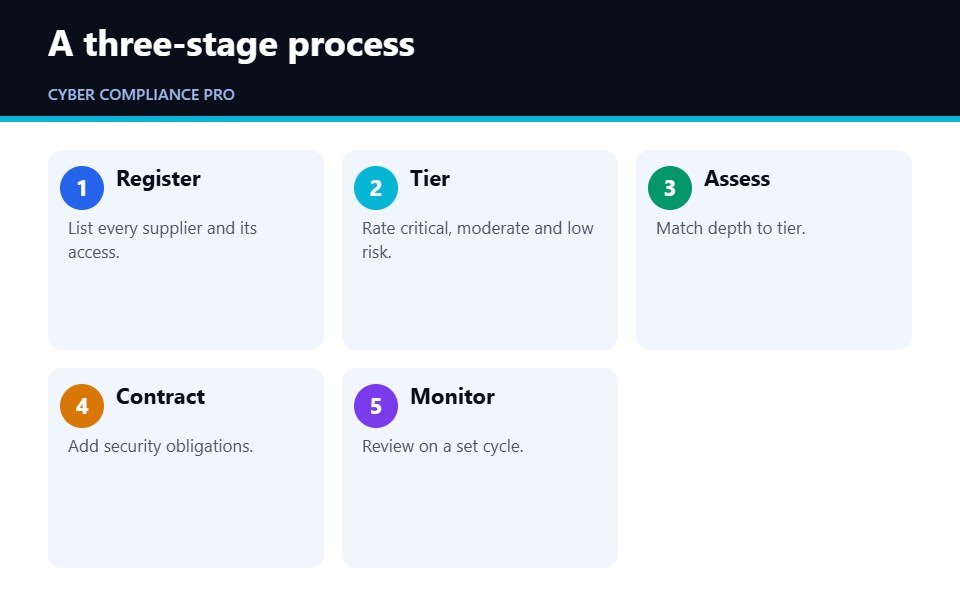
Start with a list of every supplier that touches your data, systems or customers. Record what each one does, what information it can access and who owns the relationship internally.
Then assign tiers. A critical vendor holds sensitive data or supports a core service, so its failure would hurt immediately. Moderate vendors have limited access, while low-risk vendors have none.
Tiering is what lets a small team spend time where it counts instead of treating every supplier alike.
For example, a small accounting firm might list its cloud accounting platform, email provider, payroll bureau and IT support contractor. Of these, the first and third hold client financial data, so they become critical. In practice, third party vendor risk management begins with this simple inventory.
Step 2: Assess Before You Sign
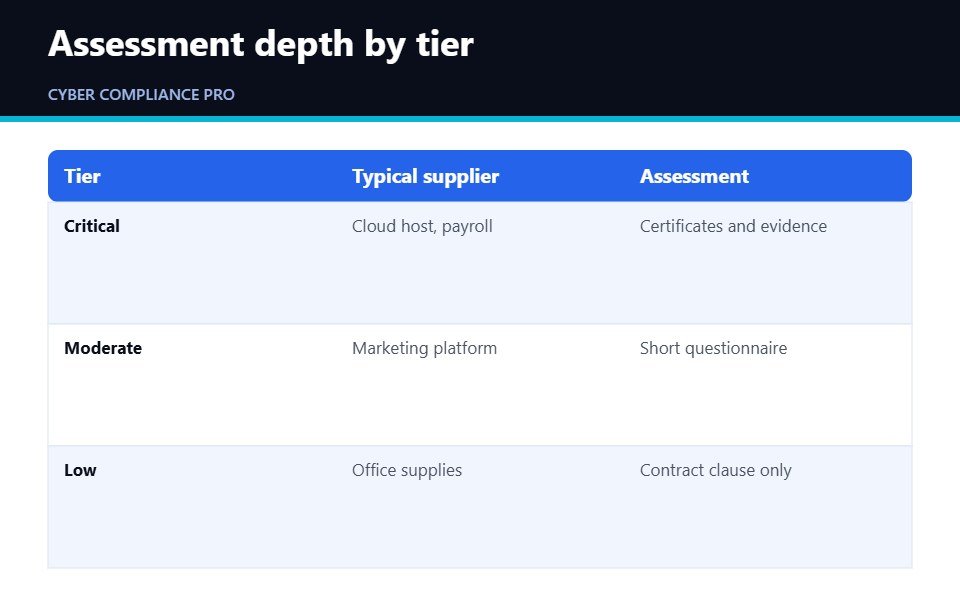
In third party vendor risk management, assessment depth should match the tier. For critical suppliers, ask for evidence such as an ISO 27001 certificate, a SOC 2 report or penetration test summaries. For moderate suppliers, a short questionnaire is usually enough. Low-risk suppliers may need only a contract clause.
Check what a certificate actually covers. Some certificates apply to only part of a business, so confirm that the services you use are inside the scope.
Want a structured way to rate risk? Our Right Fit for Risk assessment helps you match controls to the level of risk a supplier brings.
Vendor Security Questionnaires That Produce Useful Answers
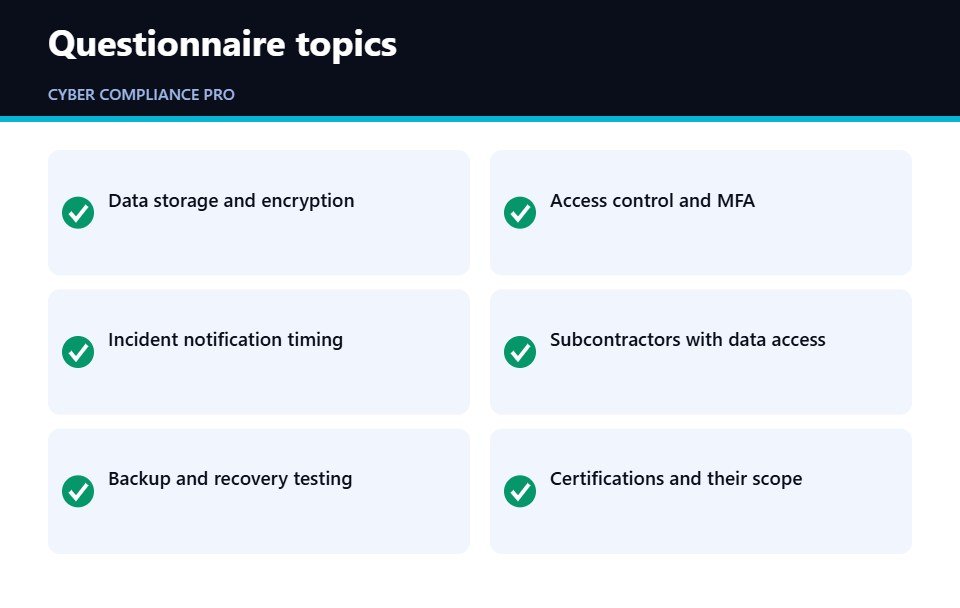
A long questionnaire is not always a good one, and third party vendor risk management works better with fewer, sharper questions. Focus on questions that reveal real control, and ask for proof where it matters.
- How is customer data stored, encrypted and backed up?
- Who can access it, and is multi-factor authentication enforced?
- How quickly will you tell us about a security incident?
- Which subcontractors handle our data?
- When did you last test your incident response and backup recovery?
Score the answers consistently and record any gaps that need a fix before you proceed. The Australian Cyber Security Centre publishes guidance on managing supply chain risk that you can use as a reference point.
Step 3: Put Controls in the Contract and Keep Monitoring
Contracts turn good intentions into obligations. Include incident notification timeframes, data handling and return rules, audit rights and security standards the supplier must maintain.
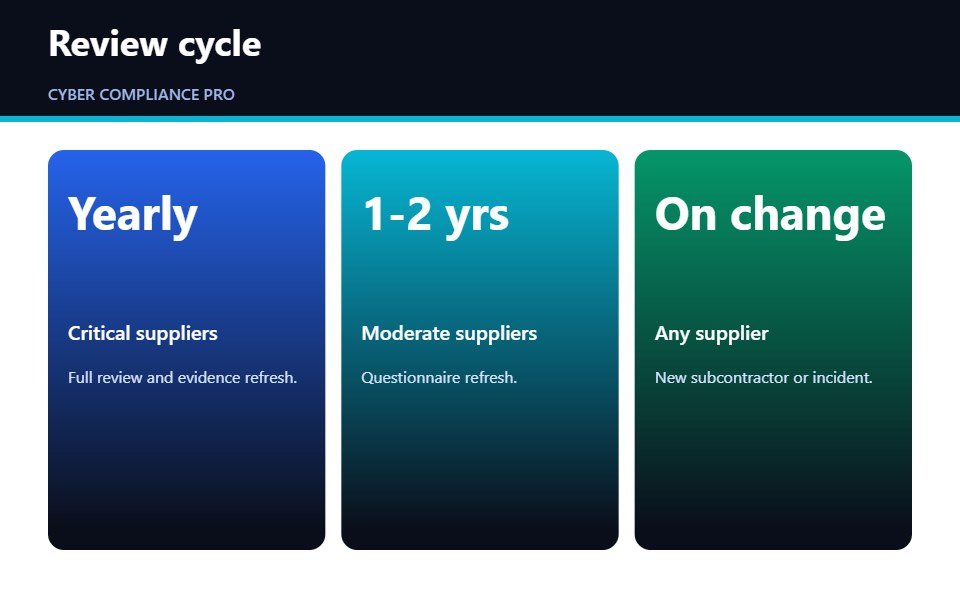
After onboarding, review critical suppliers at least yearly and moderate ones less often. Watch for changes such as a new subcontractor, a breach in the news or an expired certificate. Also prepare an exit plan, so you can move data and services if a supplier fails or the relationship ends.
Common Mistakes in Vendor Risk Programs
Many third party vendor risk management programs fail because the supplier list is incomplete. Others send one long questionnaire to everyone and never read the answers. A third group assesses once at signing and never again.
Avoid these by keeping the register current, matching depth to tier and setting a review date for every critical supplier. If a supplier handles personal information, link the work to your data breach response plan, so notification duties are clear. For wider support, our cybersecurity compliance consulting team can help you design and run the process.
Need help building a supplier risk process that fits your business?
Get in TouchFrequently Asked Questions
It is the process of identifying, assessing, controlling and monitoring the security and business risks that suppliers and service providers create for your organisation.
Start with those that hold sensitive data or support critical services, because their failure would have the largest impact.
No. Match the depth to risk. Critical vendors need evidence and detailed questions, while low-risk vendors may need only a contract clause.
Critical suppliers at least yearly, moderate ones every one to two years, and any supplier after a major change or incident.
Incident notification timeframes, data handling and return rules, audit rights, required security standards and subcontractor controls.